
Once one buys into an institution, decides to play a role in an institution, or finds oneself in a previously existing institution, he expects or hopes that there is information as to the roles in the institution and attendant expectations. Generally speaking, the more information there is about the roles, the more confident one can be in making judgments as to how successfully one is carrying out the roles. Too little information will fail to clearly delineate roles, nor allow for assessment of success and failure in playing roles. It will create an epistemological unease, which will, if left untended, undo the institution. For, moral self-evaluation is dependent upon such clarity. Lack of clarity give purchase to uncertainty, guilt, fear and ultimately, self loathing.
Now, the sort of information we are concerned with here are rules, laws, and standard operating procedures. These create roles within institutions. Human beings can be cognizant of these places within institutions because the rules that create them are cultural artifacts, what we have called “world 3 objects”, objects constructed via language, a basic institution. In virtue of these, we can read or communicate about roles, and determine our place in an institution relative to them. We can read or communicate about the roles in an institution, and decide whether we want to join that institution. We can read or communicate about roles, and form judgments as to our effectiveness in any roles we have adopted, or have involuntarily been given or born into.
There is a threshold of richness in such guiding information above which we can say that a viable institutional framework exists. (There also seems to an upper limit, of informational content beyond which, paradoxically, institutions stifle the life of those within, inhibiting creativity initiative and action, thus killing the institution’s ability to adapt to its environment. The Soviet system was a case in point.) Below that threshold, however, we would say that the preconditions of a viable institution are insufficiently met. Below that threshold, the institution is set up to fail, as it were. We see instances of this relationship between informative content and institutional health, both within the story of the SPE and within Admiral Stockdale’s narrative of life at Hoa Lo. We look at each in turn:
Zimbardo discovered that a mere assigning of roles did little toward constituting a healthy institution. He gave minimal instructions to the students who would play the guards. This gave them wide latitude to improvise. He also did not actively oversee, and, in particular, when the guards felt they were not being monitored, during night shifts, the egregious behavior tended to increase.
Even less guidance was given to the inmates. They were told to behave as they assumed inmates would behave. Zimbardo postulates a reliance on the fallback of cultural representations of prisoners, things encountered in books, movies or television shows. In both cases, individuals were left to improvise more often than not. Neither the guards nor the inmates were given a body of rules to reference, that delineated bounds of acceptable behavior. As a result, the guards began to improvise these. The prisoners didn’t create such bodies of rules for themselves. It seems we can say the greater freedom or latitude given the guards actually worked against the goal of creating a functional prison that would last the full two weeks. The prisoners, it would seem, exhibited the degree of emotional and psychological stress they did, because they failed to form a governing institutional entity and body of rules from within which they could resist, provide individual guidance or bearings for acceptable behavior, and that would have provided them some psychological or emotional armor.
Similarly, we hear from Admiral Stockdale: When he first arrived at the Hanoi Hilton, in “new guy village”, he was told in no uncertain terms by the POWs already in Hoa Lo, that it was simply unacceptable to give vague and general guidance, leaving it up to each individual to do the best he could to follow the existing code of conduct, one created after the Korean War. Instead, he had to carefully consider the end for which that code was created, the realities and limitations of human psychology and physiology, and crafted a code of conduct that was at once more specific than the official, and sufficiently detailed to give the sort of guidance craved by the inmates of Hoa Lo. His code had, built in, a clear recognition of the limits of human endurance, and directions as to what could and could not be revealed under the pain of torture. Yet, the directions were not overbearing, or weighed down with detail, leaving some room for reasonable interpretation. There was an easily memorized acronym, created for ease of transmission via the tap code. It governed all interaction with the North Vietnamese. The acronym: “BACKUS” don’t Bow in public; stay off the Air; admit no Crimes; never Kiss them goodbye, and Unity over Self, that is; never negotiate for self but for all. The system was by and large successful. Without the system, Stockdale argues that guilt would have played upon the conscience of individual prisoners, to the detriment of the POWs and the goals of the code of conduct. For, each POW was given an initial round of torture using “the ropes” maintained until he volunteered information, and was then placed in solitary. Each man felt guilt for having “broken”. With the system that Stockdale put in place, these vulnerable prisoners could delineate acceptable from unacceptable behaviors consequent to having been ‘broken’ by torture. They not only needed this structure, but reassurance.
(The term "broken" here is disputed by some POWs, who would rather substitute "bent". I believe this is because it carries with it an implication that the breakage, once accomplished was permanent. What is more accurate to say is that torture sessions eventually succeeded in creating through inflicting immense pain and physical duress, a sense of imminent death, that, not surprisingly, would yield a panicked reaction, complying with demands for information or sometimes cooperation in propaganda efforts. Key to the rules promulgated by the POW command structure was recognition of the inevitability of this panic reaction, and rules governing the nature of allowable information or cooperation. It was also made clear, the amount of torture that must be endured before one “broke.” Superhuman perfection was not expected, nor codified. Yet, one had to endure torture, for to too readily acquiesce would be to the detriment of the group and the war effort.)
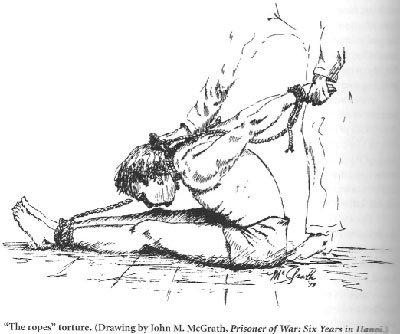
(The barbarism of ‘the ropes’ cannot be overstated. The standard procedure was to place the prisoner sitting on the floor of the interrogation room, pull his arms behind. They were then tightly bound together above the elbow so as to cut off circulation. Then, the arms were pulled up and rotated away from the back, toward the head against the normal direction of rotation while the torturer would place his foot on the upper part of the prisoner’s back, and force his upper body down between his legs, which were extended together in front. The prisoner would experience incredible pain, arms would often dislocate, tendons snap, and prisoners would be unable to breath. Many would vomit. Panic was the inevitable result.)
This is the essence of effective and engaged institutional leadership. A familiarity with the overall goal of the institution in question, and a knack for creating simple, easy to comprehend, yet informative and relatively rich bodies of laws, rules or guidelines the following of which is by and large possible for those within, and which will also allow for attainment of the goals without stifling the life of the institution or the individuals that inhabit it.
It is very interesting, and telling that the men at Hoa Lo, when purposively isolated from one another, and put under the direst of threat for attempted communications, nevertheless were compelled to seek out their neighbors, almost as tap roots seek water, while also insisting on the sort of order and body of rules here described. It is interesting that more than one described the thrill and deep sense of satisfaction in creating a civilization in the midst of barbarity.
One wants to say that this was a spontaneous expression of something deep within the human psyche, an expression of man as Homo moralis institutionalis, as intimated before. Stockdale himself uses such imagery, comparing the circumstance to the hermetic tradition. He provides this striking analogy in a commencement address, “The Melting Experience”. He likens the situation to that of the process of growing laboratory created diamond. One can place an ordinary lump of coal in a confined space, expose it to just the right combination of extreme pressure and heat, and then rapidly cool it. The end result is a diamond, an object that has instantiated a potential for beauty or excellence that was contained in the coal. Under those conditions the diamond takes up an organization or structure that lays dormant within the carbon itself.
Similarly, one can argue, pressures bring forth latent civilizing and ennobling aspects of human nature. Hoa Lo is a case in point, even if SPE was not. Extending the analogy, Stockdale argues that the set of conditions that produces the morally exemplary result is not something that naturally obtains of some necessity, but takes the careful and judicious adjustments of variables. For him, the crucial variables are recognition of the limits of human nature, and generation of appropriately calibrated rules and institutions thereby constituted. Institutions that are better adjusted to human nature and limitations will survive and flourish, given their environs, while those that are less well calibrated will fail, and occupy their place in the dustbin of history.
But, can we safely make such broad inferences? Countering that claim, one could cite, (as we did in the previous section on tradition), the fact that the men at Hoa Lo were not truly representative of raw human nature. Before they were placed in the hellish hermetic space of Hoa Lo, they were military officers. Their behavior was more a manifestation of that culture than a manifestation of some innate impulse toward morality and institutional life as a basic aspect of human nature.
Indeed, other examples exist, of uprising organized by military men in similar hellish circumstances. During the Gulag uprisings of 1952 to 1954, we see repeated instances of such events. Of particular interest is the Kengir uprising of 1954, which saw quite literally the flowering of a small temporary culture, complete with various governmental institutions, indigenous religious ceremonies, marriages, and propaganda efforts.
Yet, we should not be so quick to dismiss the postulation that these examples evidence something basic to human nature, something not attributable merely to the presence of individuals with a background in military culture. At Kengir prisoners of many backgrounds took part, and in fact initiated the rebellion before placing a military man at the head of the temporary government. There are similar cases of spontaneous relatively successful governing institutions in threatened populations that were not by and large military. One is reminded of the relatively complex and healthy governing structure created by the prison population at Sobibor concentration camp. One person was of military background, and indeed did help lead a successful uprising. However, the majority of the governing inmates were not military. Indeed, women played vital roles in that body. The governing structure actually predated the arrival of the one leader of military background. Additionally, we must not forget that the Warsaw uprising involved civilians of both genders, and all ages. Indeed, even in the Kengir uprising, many of the leading prisoners were civilians with no military background. Also, in times of disaster, institutions or organizations are spontaneously created by civilian populations that are cut off from aid.
Indeed, more broadly construed, pressure or stress in the form of environmental or climatic challenge was probably an impetus toward the formation of larger civilizations as man’s technical prowess, and increased concentrations of populations necessitated cooperation in the business of survival. Military organizations grew up with civilization.
To round out this section, we see that Hoa Lo had what SPE lacked. At SPE there was a lack of effective and engaged institutional leadership and architecture. While the “ideology” or goals of the institution were laudable (contribution to scientific knowledge), the lack of these two features increased the likelihood of the morally problematic results. Neither the guards nor the prisoners had a sufficiently robust institutional framework against which to measure their behavior. There was an ill defined immediate set of directions to ‘act the part’ and little else. On the other hand, the Hoa Lo prisoners carefully crafted realistic expectations in the form of a small set of easily transmitted rules all prisoners were expected to follow. These rules took as their basic anchor the spirit and intentions of the Code of Conduct. They were tempered with a realistic assessment of the physical and psychological limitations of human beings. There was great effort put toward dissemination of these rules and continual communications between isolated prisoners. There was a clear chain of command and equally clear explanation of the role of the prisoners as fighters ‘behind the lines.’ This savvy improvisation upon the established norm of the Code of Conduct was contributory to their success in resisting the coercion of the North Vietnamese. Lack of this careful sort of institutional architecture and leadership was contributory to the psychological and moral breakdown of the prisoners (and others) in the SPE.
What does this say about human nature and morality?
A very rough sketch:
Aristotle noted that man is the rational social animal. Kant argues that man is the animal that is capable of grasping and formulating universal laws (both scientific and moral). Popper describes us as inhabiting three worlds, one of which we create. It is populated with, among other things, laws, rules and institutions. What is essential to all three views is that we are creatures that produce and live within institutions, as coral produce reefs, or bees produce hives and colonies. What sets us apart, though, is that our ‘reefs” our institutions exist only because we mutually acquiesce or agree to limit and adjust our behaviors and implicitly or explicitly promise to act within, maintain or build upon previously existing institutions. Institutions can only exist because we can formulate goals or ends, in light of which, the institutions find their reason for existence. Institutions can only survive if the individuals that populate them survive. Institutions that stifle that life will suffer decline and eventually die. Institutions that strike an appropriate balance between the lives of the individuals contained therein and the institutional life will tend to flourish.
It was claimed earlier, that language is a basic institution, without which no other institution could exist. Institutions are essentially fabrics of mutual promising. Promises cannot be executed except within language. Elemental to the possibility of a language, is a very basic mutual implicit promise (or collective intention to use a phrase of John Searle’s) between language users. In order to effectively communicate I must agree to use words consistently with others’ usages. I cannot just decide to assign novel meanings to words without destroying the very possibility of communicating, and indeed language itself. So, implicit in the basic human institution is something very like what Kant would call a universal moral imperative. One can postulate that there is a system of such basic moral imperatives. We can call this ‘the basic moral system' or 'basic moral institution.' Most, if not all elements of this basic system can be seen as reciprocal promises (implicit or explicit) to behave toward other human beings in certain ways. One can take the measure of an institution, and indeed individual human beings by assessing the extent to which they honor these collective intentions or mutual implicit promises.
Now, if, as seems entirely plausible, it is natural for human beings to develop and use language, then, it is natural for them to develop the aspects of the basic moral system or institution that it requires. Now, if language is the basic institution, and is dependent on the basic moral institution, then it should then not be at all surprising that it is natural for language users to develop the sorts of second order institutions that depend on language and the basic moral institution for their existence, if conditions are right, that is; if conditions dictate creativity by way of bringing about or instantiating a ‘hermetic’ setting.
So, yes, indeed there are diamonds innate in our human lumps of coal. This is not to say that we will always end up with diamonds. No, that should no more be expected than that most parameter setting used in a lab experiment will prod coal to produce gem stones. Be that as it may, judicious and rational exploration of the parameters of human being, and institutional design, will allow us to approach that gem, balancing the rights and responsibilities of the individual against the interests, rights and responsibilities of our institutions, keeping both ‘healthy, wealthy and wise’. That is the task of ethical leadership.

No comments:
Post a Comment